
This Friday, for twenty-four hours, Bandcamp will take nothing from a sale. Everything a listener spends lands with the artist, minus the card fee. The artists know it's coming, the fans know it's coming, and by Thursday night the whole independent world is posting the same sentence: today it all goes to the artist.
It began on 20 March 2020, the first Friday of lockdown, as an emergency measure for musicians whose tours had vanished overnight. Six years on it's still here: eight dates in 2026, on days Bandcamp chooses.
We think it's the most successful marketing campaign independent music has ever run. And the product it sells is fairness.
Fifteen times a normal Friday
Since that first Friday, Bandcamp says these days have routed more than $154 million to artists and labels, $19 million of it in 2025 alone, more than the whole of the year before.
On the first one, fans bought nearly 800,000 items, fifteen times a normal Friday, and the music hadn't changed. It had been sitting there, unbought, on the Thursday.
What changed was that everyone asked at once. Artists posted. Labels waived their own share too. And behind every ask was a fact the fan could be sure of: the money goes to them. Fans want to pay the person. Ask them directly, make sure they know it will arrive, and they turn up.
That's not a promotion result. It's a demand signal.
What the artists told us
Towards the end of last year we ran a series of interviews with independent musicians, many of them making the long, deep kind of work Indee was built for. We were asking a simple question: where does their income actually come from?
The answer was nearly always the same, and it wasn't Spotify. The real money came through Bandcamp.
"The only time I've ever really earned anything from my music was through Bandcamp."
But every one of them had generated the interest themselves. An email list. A run of posts. Private messages to the people who had always supported their work. Nobody we spoke to was being discovered on Bandcamp. They were sending their own audience there, to pay.
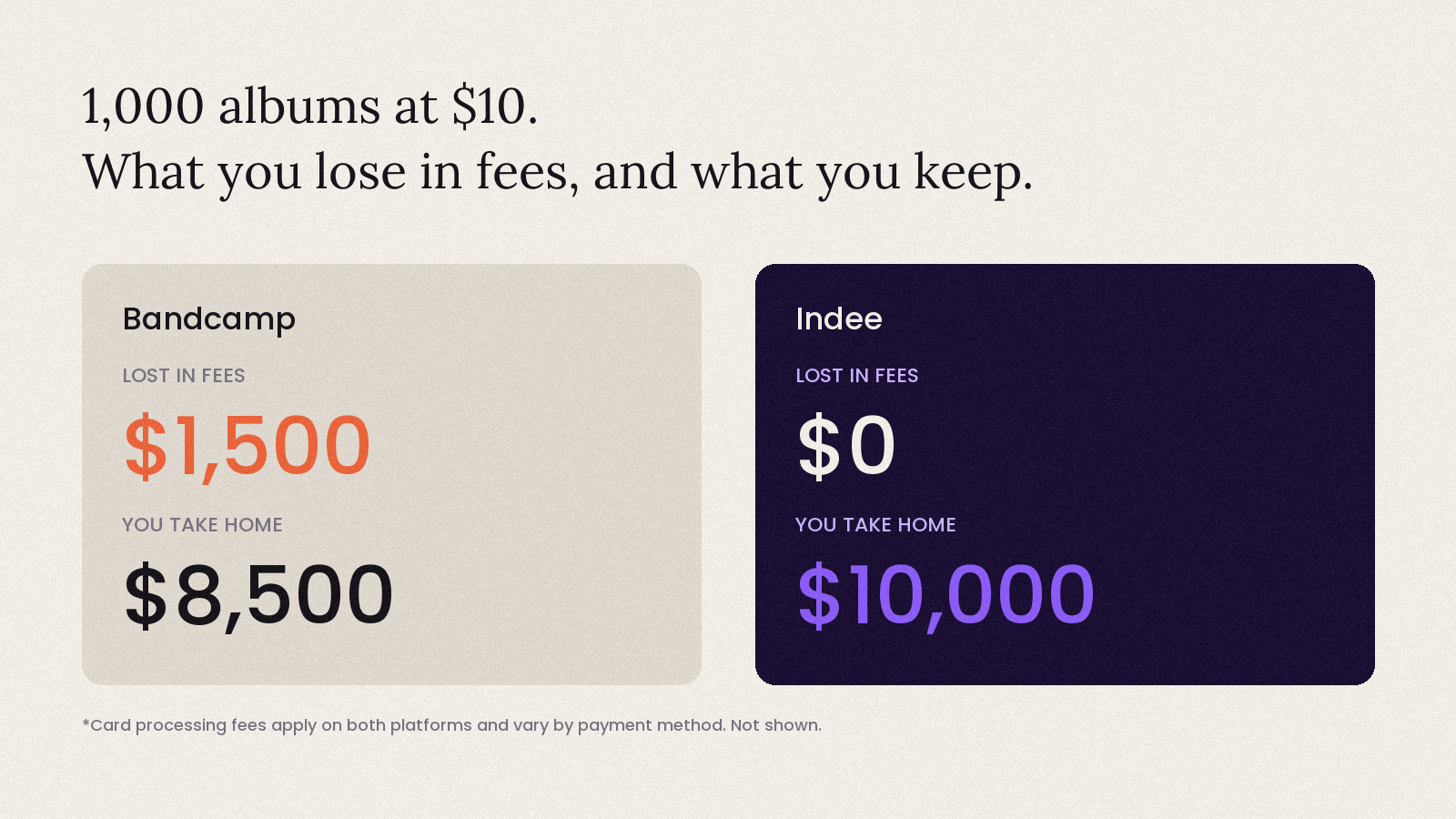
Bandcamp, in other words, was the checkout. And as a checkout it's expensive: 15% on a digital sale, with the card processor's fee on top, so close to a fifth of what a listener pays never arrives. And the discovery the fee pays for isn't the part these artists were using.
One detail struck us. The listeners buying these albums, the ones who'd waited for the early release, mostly went and listened on Spotify afterwards anyway. They bought to support the artist, then played the music wherever their playlists lived. So the purchase wasn't really about playback. It was the one moment a listener could put money in the artist's hand, and the artist lost nearly twenty in every hundred dollars at exactly that moment.
Which suggests the thing that's worth the artist owning is the moment of support, and what they offer in it: the early listen, an extended version, the exclusive piece that never went to the streaming services, a way to give more than the price of the album. The artists we spoke to who did best on Bandcamp were the ones offering something you couldn't get on Spotify.
One artist we spoke to had even done the sums, and hosted the checkout for her last album herself.
Where Bandcamp earns its share
If Bandcamp sends you someone new, 15% of a sale you'd never otherwise have made is a good trade. And the rest of what the fee pays for is real: streaming, playback, downloads, payments, a page that works on every phone. Building that yourself is harder than it looks.
What we saw was artists paying that fee on sales they'd generated themselves, to people who already knew where to find them. And who didn't end up listening on Bandcamp anyway.
What Indee believes
Every day should be Bandcamp Friday. Creativity should be free to take whatever shape it needs and go as deep as it wants, without a format deciding for it. And the relationship with the people who support the work should belong to the artist.
So how does Indee get paid? It's a transparent subscription: $19 a month to host, stream and protect your work. It's great for the longer form audio listeners actually want to pay for and the algorithm doesn't reward. We never take a cut from your income, a listener pays straight into your own account, and the only fee is Stripe's for processing the card. And there's a free plan for sharing free work. We don't bring you listeners. And we dont cross sell other people's work to your audience.
And we recognise that a lot of the people who support you want to give more than the album itself. They're usually the ones who've been with you the longest. On Indee they can, with a gratitude payment any time they feel called to, and every one of those goes to you as well.
The other 357 days
Deadlines work. Bandcamp Friday is proof. But this one is set by someone else, and on that day, your release stands in the noise of every other release, shouting into the same twenty-four hours.
You could run your own. Point the campaign for the next release at one place you own, where "this goes to me" is true by default, and where the same listener can send gratitude, come back for the longer thing you made after the album, and be on the list when the next one is ready. Not a shop. A relationship, with a mechanism for reciprocity baked in.
Some artists try to build this on a website builder and get stuck at the same three places: streaming the audio, taking the payment, and letting only the right people in. That is the whole job Indee does. We exist to power creative sovereignty and independence.
This Friday
Please go and buy something. Support the music and the ones who create it, wherever their work lives. The world needs more of their creativity right now, and they need more recognition and fairness in return.
And if you're planning a release around a Bandcamp Friday this year, we'd love to hear how you're doing it, what serves your work and what gets in the way. Write to us.
Naveed Akram is the founder of Indee, quiet infrastructure for creators of listening experiences. Earn directly from the people your work was meant for, at indee.co.